The Handwriting Breakthrough: How GenAI and IDP are Solving Healthcare’s Biggest Data Bottleneck
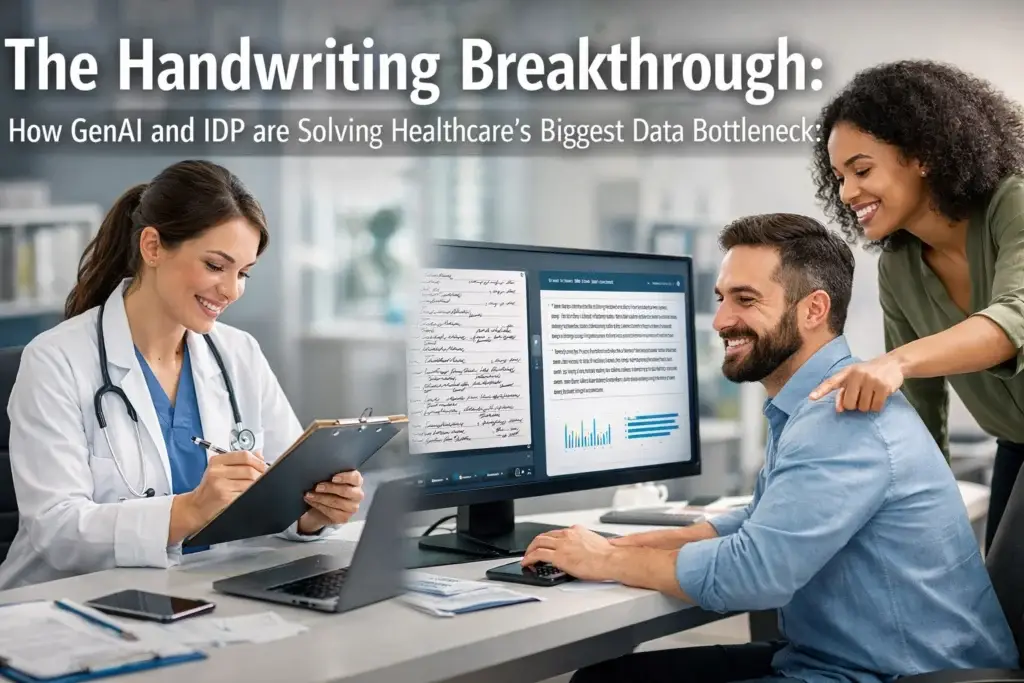
In the high-stakes world of healthcare and insurance, data is the lifeblood of every decision. Yet, a staggering amount of that data remains “trapped” in a format that has plagued IT directors for decades: the handwritten document. Whether it is a hurried physician’s note on a referral, a complex medical history form, or a signed prescription, handwriting has long been the ultimate bottleneck in clinical workflows.
For years, the industry has relied on traditional Optical Character Recognition (OCR) to bridge the gap between paper and digital systems. But let’s be honest: OCR has often felt like trying to read a roadmap through a fogged-up windshield. It worked well enough for typed text, but the moment a human hand picked up a pen, the system crumbled, leading to manual data entry, mounting backlogs, and costly errors.
This begs the question: In an era of AI-driven diagnostics and robotic surgery, why are we still struggling to read a doctor’s signature?
The answer lies in a technological shift that is finally catching up to the complexity of human handwriting. By combining Intelligent Document Processing (IDP) with the power of Large Language Models (LLMs), we are witnessing a breakthrough that turns the “unreadable” into actionable, structured data.
The Traditional OCR Wall vs. The IDP Revolution
To understand why this matters, we first need to look at what went wrong with traditional methods. Traditional OCR is template-based and “rigid.” It looks at a character, tries to match it to a known font, and makes a guess. If a loop is too wide or a line is too faint, the system fails. In a healthcare setting, this “failure” means a human staff member has to step in, manually type the data into an Electronic Health Record (EHR), and hope they didn’t misinterpret a “5” for an “S.”
Intelligent Document Processing (IDP) is fundamentally different. Unlike its predecessor, IDP doesn’t just look at shapes; it understands context.
When we integrate GenAI: specifically advanced models like Google’s LLM: into the IDP workflow, the system begins to “read” more like a human. It recognizes that if a word starts with “Lipi,” the next few scribbled characters are almost certainly “tor,” because it understands the medical context of cholesterol medication.
At Ingenium, we’ve seen this firsthand. By leveraging the ETHERFAX Flow platform, we are now able to offer recognition capabilities that were previously thought impossible. During recent testing, the document classification and handwriting recognition powered by ETHERFAX Flow showed an uncanny ability to decipher even the most “creative” physician handwriting with startling precision.
The Real Cost of the Paperwork Bottleneck
Why is this a priority now? Because the “paperwork burnout” is no longer just an administrative headache; it’s a financial and operational crisis.
In today’s healthcare environment, the cost of processing a single complex document manually: from receipt to data entry: can average $20 per document. When you multiply that by the thousands of faxes and forms a large hospital or insurance payer receives daily, the numbers are staggering.
Beyond the direct labor costs, there are three critical areas where the data bottleneck hurts the most:
1. Referral Leakage
In a competitive healthcare market, speed is everything. If a specialist’s office receives a handwritten referral via an online fax service and it sits in a queue for 48 hours waiting for manual entry, that patient is likely to go elsewhere. ETHERFAX Flow eliminates this delay by triaging and extracting data the moment it arrives.
2. Administrative Burden and Burnout
Staff members in “triage” roles are often overwhelmed. They spend their days performing “stare and compare” tasks: looking at a scanned image and typing what they see into a system. This is high-stress, low-value work that contributes directly to the high turnover rates in healthcare administration.
3. Accuracy and Patient Safety
Traditional transcription error rates in medical documents hover around 8-12%. When those errors involve medication dosages or allergy alerts, the stakes are life and death. Modern IDP systems, such as ETHERFAX Flow, are now achieving 98.5%+ accuracy rates right out of the box.
How GenAI Changes the Game for Handwriting
Doug Olive, President of Ingenium, recently explored ETHERFAX Flow and his testing outcomes highlight a major leap forward: the shift to reliable and low cost LLM-based recognition.
Here’s where the “magic” happens. Modern GenAI models are trained on millions of variations of human writing. They don’t just recognize a character; they perform contextual validation.
Stroke Pattern Analysis: The AI understands the physics of how a pen moves, allowing it to reconstruct words even when characters overlap.
Medical Knowledge Integration: By cross-referencing recognized text with drug databases, ICD-10 codes, and clinical terminology, the system self-corrects. If it sees a handwritten “5ng,” it knows that “5mg” is the clinically relevant term.
Few-Shot Learning: Unlike old systems that required thousands of samples to “learn” a specific doctor’s handwriting, GenAI can adapt to a specific style with just a few examples.
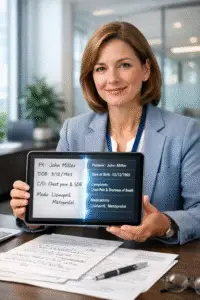
Bridging the Gap: Fax to IDP
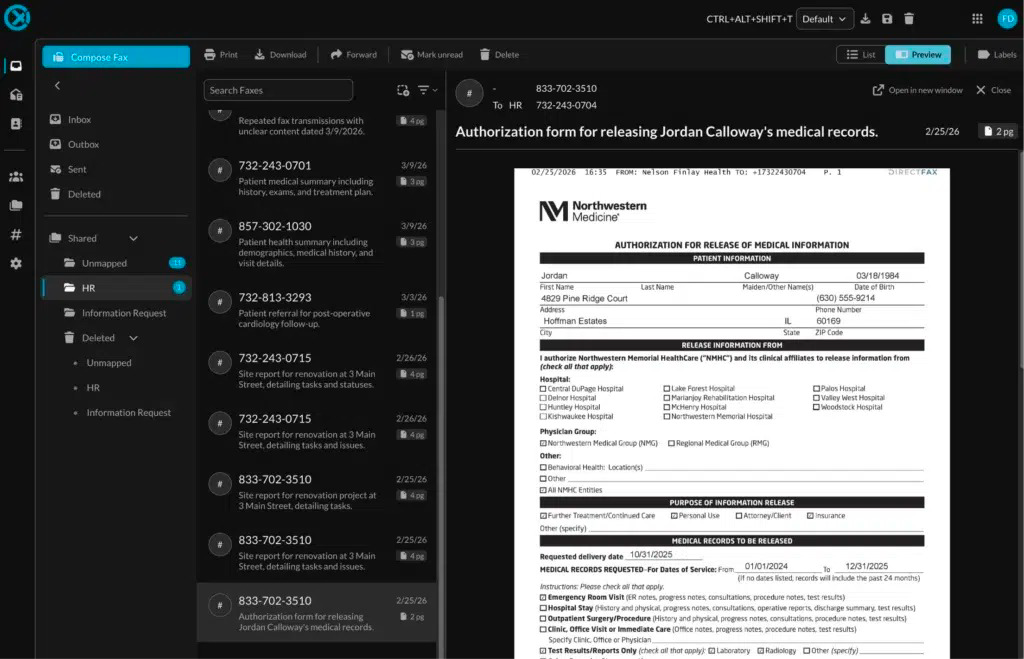
You might wonder why a company specializing in fax solutions is so focused on AI and document processing. The reality is that in healthcare, fax is the primary transport layer for unstructured data.
While the world has moved to email and APIs, the secure, easy to use, legally binding nature of fax means it isn’t going anywhere. The challenge isn’t replacing the fax; it’s making the data inside the fax smarter.
By connecting Ingenium’s mission-critical fax infrastructure: whether it’s an on-premises RightFax server or a cloud-based fax service: with an IDP engine like ETHERFAX Flow, we create a “Smart Fax” ecosystem.
Capture: A handwritten referral arrives via your secure cloud fax.
Classify: The IDP identifies it as a “Referral Form” for “Cardiology.”
Extract: The ETHERFAX Flow reads the patient name, DOB, and the physician’s handwritten notes.
Validate: The system checks the data against your EHR (Epic, Cerner, etc.) or insurance database.
Route: The structured data is injected directly into the workflow, and a notification is sent to the triage nurse.
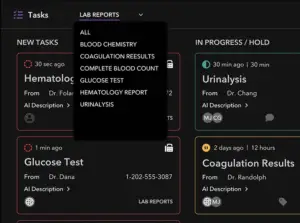
Impact on the Insurance Industry
It isn’t just hospitals that benefit. Insurance payers deal with a mountain of handwritten claims, appeals, and prior authorization requests. For a major healthcare provider, the ability to automate the intake of these documents can save millions in operational overhead.
When an insurance adjuster doesn’t have to manually decipher a handwritten appeal, the entire claims cycle accelerates. This leads to faster provider reimbursements and higher member satisfaction. In essence, IDP turns a cost center (document processing) into a competitive advantage.
Implementing IDP: What You Need to Know
Transitioning to an IDP-enhanced workflow doesn’t mean you have to rip and replace your current systems. At Ingenium, we believe in the power of hybrid technology.
If you are currently running a fax server, you can integrate IDP as an intelligent layer that sits on top of your existing fax numbers. For those looking to move away from hardware entirely, a cloud-based fax server technology provides the perfect turnkey “Smart Fax” foundation for GenAI integration.
Key considerations for your implementation:
- Compliance is Paramount: Ensure your IDP provider is HIPAA-compliant and offers HITRUST certification. Data extraction must happen in a secure environment.
- The “Human in the Loop”: No AI is 100% perfect. The best IDP workflows include a “human-in-the-loop” interface where staff can quickly verify any low-confidence extractions.
- Integration Ease: Look for solutions that offer pre-built connectors for major healthcare platforms (Epic, Athenahealth, Salesforce Health, Cerner, Click Point Care, etc.) to ensure a seamless data flow.
Conclusion: The End of the Data Silo
The “Handwriting Breakthrough” is more than just a cool piece of tech; it is a fundamental shift in how healthcare operates. By leveraging GenAI and IDP, we are finally eliminating the “paper trail” that has slowed down patient care and drained administrative budgets.
Gone are the days when a handwritten note was a dead end for data. Today, that note can be the start of an automated, efficient, and error-free clinical workflow. Whether you are looking to reduce administrative costs or simply want to free your staff from the drudgery of manual data entry, the combination of Ingenium’s fax expertise and the ETHERFAX Flow IDP solution is the way forward.
Now is the time to look at your incoming document streams and ask: How much more could we achieve if we could actually read everything we receive?
Ready to see how Intelligent Document Processing can transform your workflows? Contact us today to learn more about our integration with ETHERFAX Flow and how we can help you solve your biggest data bottlenecks.